Every growth plan works in a spreadsheet.
Find the one that survives the market.

Principle simulates the competitors, customers and regulators around your growth plan across hundreds of possible futures, so you see which path gets you to your target, and what breaks it, before you commit capital.

Private equity

Should we buy this company, and which growth path gets it to 3×?

Between IOI and LOI, alongside your commercial diligence. On one live deal, the obvious acquisition failed: the share it was meant to buy was gone before the deal would have closed.

Portfolio & value creation

Is the plan still on track?

After close, the simulation keeps running against live market signals, so the value-creation team sees when to double down, pivot or prepare the exit, before the quarter tells them.

Corporate growth

Which market, which acquisition, which launch?

Before the board commits budget, see how competitors, customers and regulators respond to each option, from the path to IPO to entering a new category.

Capital allocators

Where do we double down, divest or diversify?

Take AI data centers. Every site is a bet on power, chips and demand at once. Principle plays the grid operators, hyperscalers and regulators forward and shows which sites still pay off, and which ones the whole book quietly depends on.

LLMs summarize what's known. Principle simulates what's next.

Ask ChatGPT or Claude about a growth plan and you get one confident timeline, reasoned backward from the past. Principle reasons forward: every competitor, customer and regulator pursues its own goals against your plan across hundreds of futures, and every outcome traces back to the events that caused it.

Test the plan before you commit capital.
Know what breaks it before the market does.

How Principle works

Model your world

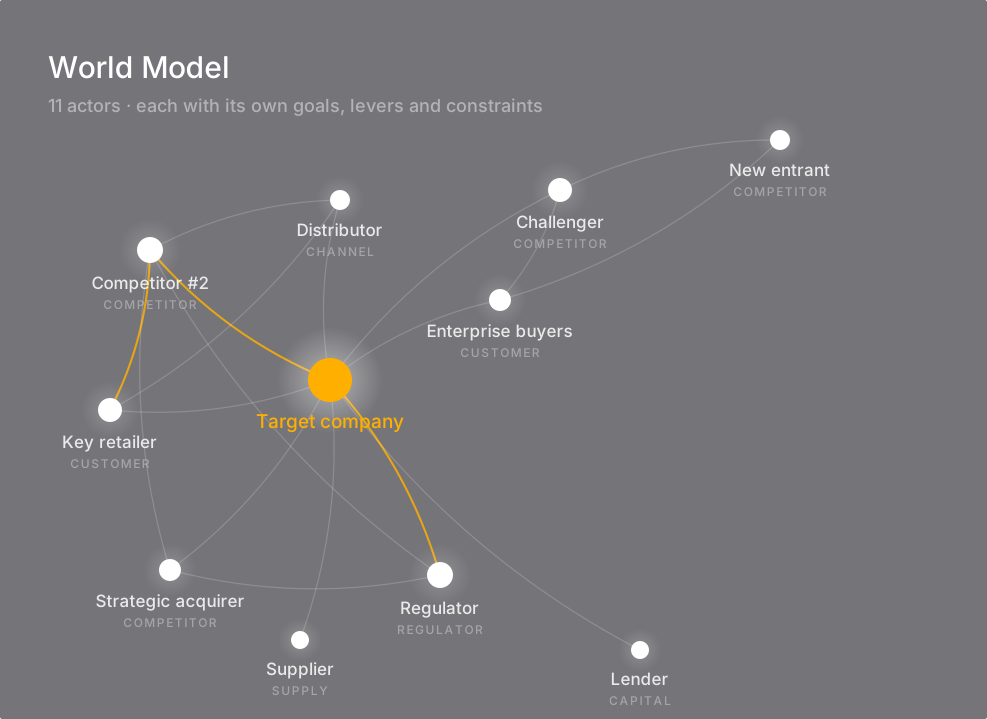
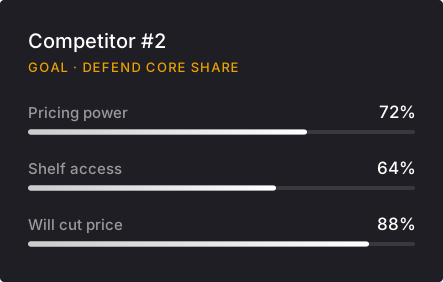
Your company, its competitors, customers and regulators become named actors, each with its own goals, capabilities and constraints. The world starts from your data room, public sources and live market signals.

Run your growth paths

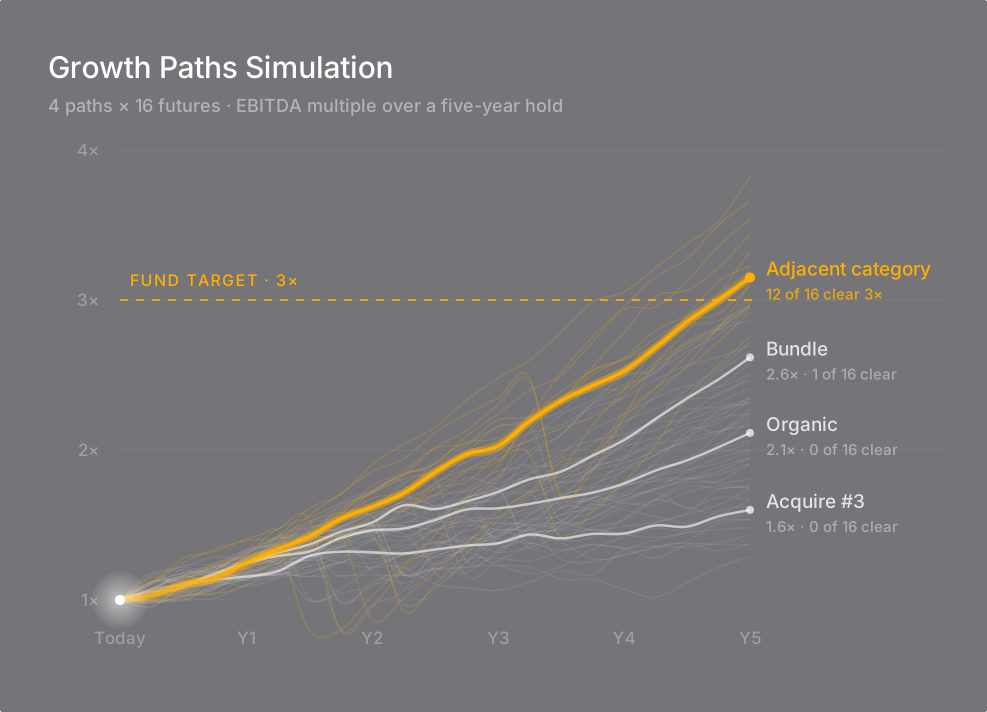
Organic growth, an acquisition, a new market: each path plays out quarter by quarter across futures from base case to downturn, scored against your target. Most paths miss. Now you know which one doesn’t.

See what holds, and why

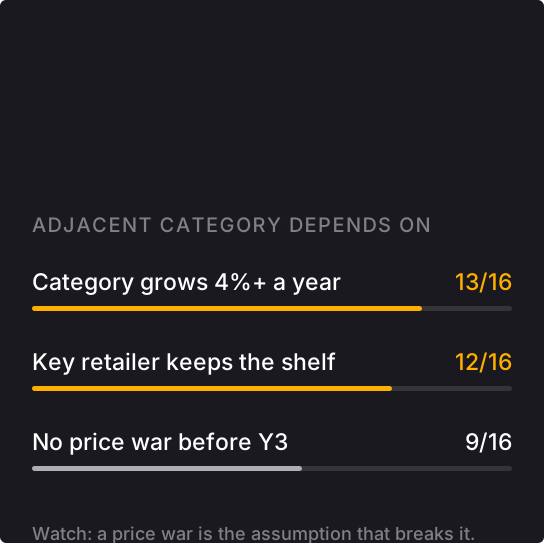
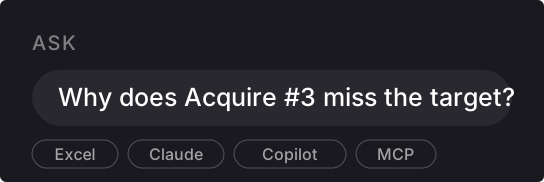
Every event links to what caused it, so you can trace any number to its source and see which assumption a path depends on. Ask questions in plain words, in Principle or from Excel, Claude and Copilot.

What gets tested

Every bet a growth plan rests on

Market entry

A new country, segment or channel. Who answers first, how hard, and how long until the share is real.

Acquisitions & roll-ups

Buy the number three, or build. What the market looks like by the time the deal closes and integration lands.

New products & adjacencies

An adjacent category, a bundle, a licensing play. Which one customers adopt and which one competitors copy.

Pricing & positioning

A price move, a premium tier, a channel shift. How rivals, distributors and customers react quarter by quarter.

Downturns & shocks

A recession, a rate shock, a new rule. Which assumptions break first and which paths still clear the target.

Exit & capital paths

IPO, strategic sale or hold. Which story the market will pay for in year five, and what has to be true to get there.

Test your growth plan

Case studies

What the simulations found

Three questions, three kinds of capital, one method: model the market, run every path, and see what breaks before it does.

Private equityMultibillion-dollar buyout fund · deal team

Four growth plans. None cleared the return target.

The question: which growth plan gets the target, one of two leading brands in a concentrated consumer category, to 2.5× EBITDA over a five-year hold? Four plans ran against the full range of category outcomes.

2.5× TARGETOrganicAcquire #3AdjacentBundle
Best case of each plan, across 16 futures

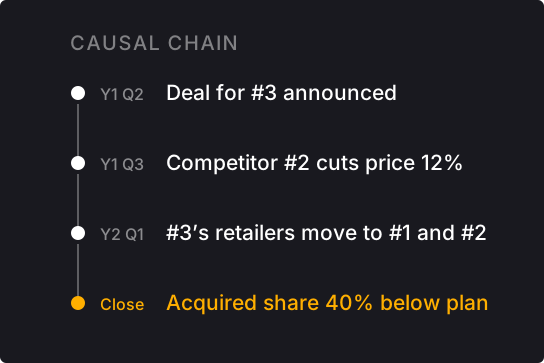
The surprise: the obvious move failed. Buying the declining number three to take its share did not work, because by the time the deal would have closed, that share had already gone to the other two players.

11
market actors
16
futures
14,300
market events
Wealth ManagementGlobal bank · Hong Kong wealth market

Simulated in May. Confirmed 24 days later.

The bank was watching the rival it expected. The simulation flagged a different one: a US bank quietly growing its Asia share by hiring senior private bankers while the market for them tightened.

  1. 18 MaySimulation built. Rival’s hiring push appears in the simulated futures.
  2. 11 Jun · +24 daysConfirmed in public reporting: the rival’s Singapore team doubled, Asia assets up 41%.
14 dated claims: 4 came true, 1 partly, 9 still open

Principle beat two other vendors head-to-head on the same brief. Every claim carries a date and gets scored when it resolves.

Software CompanyBootstrapped to $100M+ revenue

Which path to an IPO valuation, and in what order?

The goal was an IPO, and the multiple sat below it. Three paths could close the gap: sell the cash cows, run a PE-style roll-up, or pivot to a pure play.

The strategies that won on near-term revenue scored lowest on the long-term valuation an IPO depends on. The value was in the sequencing. Walking through the sell-side case, the CEO asked who the real buyers would be. The simulation named them, several of them already quietly engaged with the company, with no CRM and no relationship history behind it.

90
market actors
480
scenarios
24
month horizon

“We build on Apple’s platform, so every WWDC reshapes our market, and we treat that as an opportunity to move first. Principle’s simulation predicted 7 of Apple’s 2026 announcements before the keynote, so we walked in already knowing where to place our bets.”

CEO and Founder, software company

Research

We publish the tests others skip

A simulation is only worth what it gets right. So we test against prediction markets, where every forecast has a date and a verified answer, and we publish the results, including the ones that make AI look bad.

ICML 2026AI Forecasting workshop · peer-reviewed
64–72%of LLM forecasts wrong, even with the right context, across four frontier models

Measuring source-induced bias in LLM forecasts with prediction markets

  • 111 markets
  • ~93,000 predictions
  • p < 10⁻⁶

Finding: the bias lives in the sources, not the model. A better LLM does not fix it. Calibration does.

Powers our calibration layer

Khandoga, Kostiuk, Polishko, Filipchuk, Kozlov, Zamriy, Kiulian

Read the paper ↗
NeurIPS 2026FMTS workshop · peer-reviewed
~5%of the inference cost, ahead of every frontier model tested, Claude Opus 4.5 included

Do your own research: agentic forecasters that beat frontier models

  • 2,100+ resolved questions
  • 3B active parameters
  • calibration +30–40%

Finding: a small open model, trained in our environment to gather its own evidence, out-forecasts frontier APIs.

Powers the actors in every simulation

Afifi, Kiulian, Polishko, Khandoga, Naanaa, Krasnobrizha

Read the paper ↗

How every simulation is calibrated

  1. 01Market calibrationWorlds start from real data, actor profiles and expert interviews, with the source bias above measured and corrected.
  2. 02Continuous actor feedbackReal events are scored against every simulated world, and the results feed the next run.
  3. 03Outcome resolutionEvery forecast gets a date, and a score when it resolves. Right or wrong, it stays on the record.

Built by scientists who know when to trust a simulation: Monte Carlo at CERN, agent-based simulation at Google scale, quantum plasma physics, decision systems for the White House COVID response.

Meet the team ↗

In the press

“Principle ran a simulation of the enterprise AI market. In 110 of 123 possible futures, lack of power was the main constraint on growth: not the chips, not the models, just lack of power.”
John Koetsier · Forbes · June 2026
“Strategic simulation is AI's next frontier for enterprise decision-making and leadership.”
Entrepreneur · July 2026
“Every dollar a corporation or investor commits is a bet on a direction. If everyone can execute anything, execution stops being the moat. The expensive skill becomes direction.”
Quartz · August 2026

Our Strategic Intelligence Community

Principle's Strategic Intelligence Community is an invitation-only private network for operational and strategy leaders across the Fortune 500, designed to bring together leading strategists to stress-test the future. We track critical signals, you stress-test scenarios, and the community comes together to reveal blind spots.

Open exclusively to VP/Directors of Strategy, Operations, or Engineering within companies of >$500M revenue and/or >1000 person headcount.